Harvard Referencing Examples: 50+ UK Examples for Every Source (Easy Guide)
Harvard is the most widely used referencing style at UK universities, yet it is also one of the most common places students lose marks. A missing year, a misplaced comma or an inconsistent reference list can make otherwise excellent work look careless. This guide gives you Harvard referencing examples for more than 50 source types, with matching in-text citations, so you can copy the pattern for any source you use.
The examples follow the Cite Them Right version of Harvard, which most UK universities base their guidance on. Always check your own module handbook, because some institutions make small changes to punctuation or formatting. If you are unsure which style your course uses, read our guide to the best referencing styles for UK universities.
Note: the authors, titles and URLs in the examples below are illustrative. Replace them with the details of the real sources you use.
What Is Harvard Referencing?
Harvard is an author–date referencing system. It has two parts that always work together:
- In-text citations — short references in the body of your work, giving the author’s surname and the year of publication, for example (Smith, 2023).
- A reference list — a full list of every source you cited, arranged alphabetically by author surname at the end of your work.
Unlike footnote styles such as OSCOLA or Chicago, Harvard keeps references inside the text, which makes it quick to read and easy to check. It is the default style for most business, social science, education, health and humanities courses in the UK.
Is MLA the Same as Harvard?
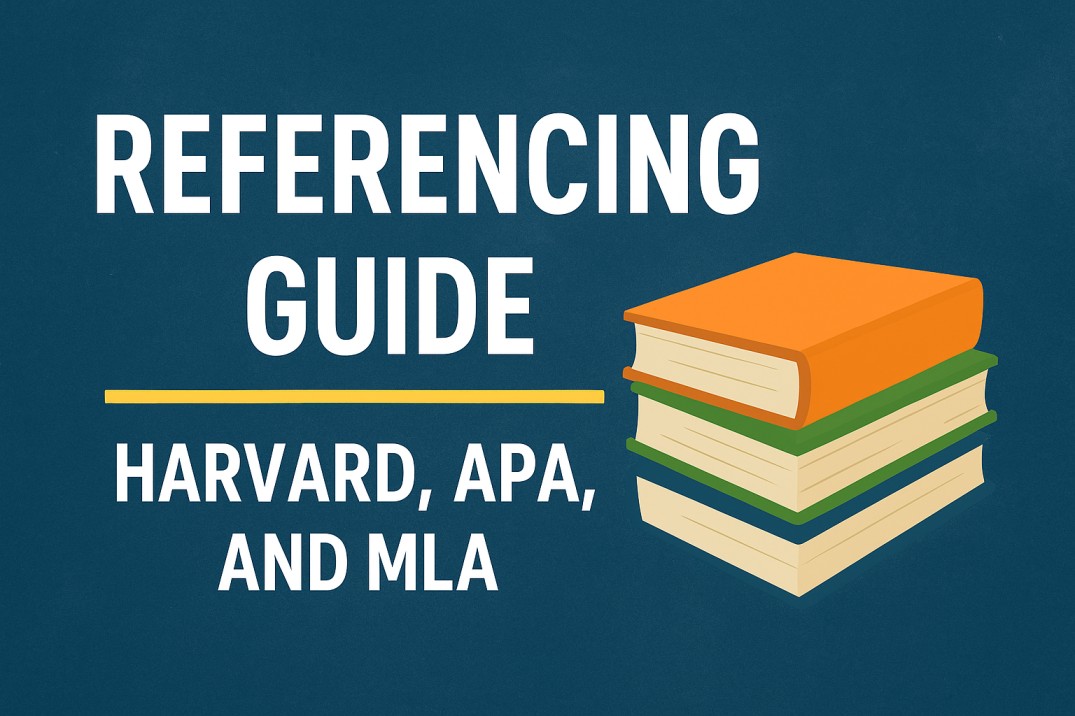
No. This is one of the most searched referencing questions, and the confusion is understandable because both are “parenthetical” styles. The key differences are:
| Feature | Harvard | MLA | APA 7 |
|---|---|---|---|
| In-text format | (Author, Year) or (Author, Year, p. X) | (Author Page) — no year | (Author, Year, p. X) |
| List title | Reference list | Works Cited | References |
| Year position | Straight after author, in brackets | Near the end | Straight after author, in brackets |
| Main UK use | Most UK subjects | English literature, modern languages | Psychology, some health courses |
| Article titles | In single quotation marks | In double quotation marks | No quotation marks |
So if your handbook says Harvard, do not use MLA examples — the in-text citations and reference list entries will be wrong.
What Citation Style Is Used in the UK?
There is no single national style, but Harvard is by far the most common across UK universities. Law schools usually require OSCOLA, psychology departments often use APA, and some humanities subjects use MHRA or Chicago. Each department publishes its required style in the module or programme handbook, and that always takes priority over general guides.
Harvard In-Text Citation Examples
Every source in your reference list must be cited in the text, and every in-text citation must match an entry in the list. These Harvard referencing examples show the most common in-text patterns.
| Situation | In-text citation example |
|---|---|
| One author | (Taylor, 2022) |
| One author, direct quotation | (Taylor, 2022, p. 47) |
| Quotation across pages | (Taylor, 2022, pp. 47–48) |
| Two authors | (Khan and Evans, 2021) |
| Three authors | (Khan, Evans and Lee, 2021) |
| Four or more authors | (Patel et al., 2020) |
| Organisation as author | (Office for National Statistics, 2024) |
| No author | (Title of Work, 2023) |
| No date | (Brown, no date) |
| Two works by same author, same year | (Ali, 2023a; Ali, 2023b) |
| Several sources at once | (Green, 2019; Moore, 2021; Shah, 2023) |
| Secondary source | (Freire, 1970, cited in Hughes, 2022) |
Narrative vs Parenthetical Citations
You can place the author’s name in your sentence (narrative citation) or in brackets (parenthetical citation):
- Narrative: Taylor (2022) argues that feedback improves student motivation.
- Parenthetical: Feedback has been shown to improve student motivation (Taylor, 2022).
Using a mix of both makes your writing flow better and shows the marker that you are engaging with authors rather than simply listing them.
Harvard Referencing Examples: Books
Books are the backbone of most reading lists. The basic pattern is: Surname, Initial(s). (Year) Title. Edition (if not the first). Place of publication: Publisher.
1. Book with one author
Reference list: Taylor, M. (2022) Understanding Student Motivation. London: Academic Press.
In text: (Taylor, 2022)
2. Book with two or three authors
Reference list: Khan, S., Evans, R. and Lee, J. (2021) Research Methods for Business Students. Harlow: Example Publishing.
In text: (Khan, Evans and Lee, 2021)
3. Book with four or more authors
Reference list: Patel, A. et al. (2020) Public Health in Practice. Oxford: Example University Press.
In text: (Patel et al., 2020)
4. Later edition
Reference list: Moore, D. (2021) Marketing Management. 4th edn. London: Example Books.
In text: (Moore, 2021)
5. Edited book
Reference list: Green, L. (ed.) (2019) Contemporary Issues in Education. Bristol: Example Press.
In text: (Green, 2019)
6. Chapter in an edited book
Reference list: Shah, P. (2023) ‘Digital learning in higher education’, in Green, L. (ed.) Contemporary Issues in Education. Bristol: Example Press, pp. 45–67.
In text: (Shah, 2023)
7. E-book
Reference list: Brown, K. (2020) Leadership in the Digital Age. Available at: https://www.example-ebooks.com/leadership (Accessed: 12 November 2026).
In text: (Brown, 2020)
8. Translated book
Reference list: Dubois, C. (2018) The Sociology of Work. Translated by H. Wright. London: Example Books.
In text: (Dubois, 2018)
9. Book by an organisation
Reference list: Royal College of Nursing (2022) Guidance on Clinical Supervision. London: RCN.
In text: (Royal College of Nursing, 2022)
Harvard Referencing Examples: Journal Articles
Journal articles carry the most weight in a literature review. The pattern is: Surname, Initial(s). (Year) ‘Article title’, Journal Title, Volume(Issue), page range. Available at: DOI or URL.
10. Journal article with a DOI
Reference list: Evans, R. (2021) ‘Assessment feedback and student engagement’, Journal of Higher Education Studies, 14(2), pp. 112–129. Available at: https://doi.org/10.0000/example.2021.0142.
In text: (Evans, 2021)
11. Journal article without a DOI
Reference list: Lee, J. and Ahmed, N. (2022) ‘Remote work and wellbeing’, Management Review Quarterly, 8(4), pp. 23–41. Available at: https://www.example-journal.com/article/remote-work (Accessed: 12 November 2026).
In text: (Lee and Ahmed, 2022)
12. Print journal article
Reference list: Clarke, H. (2017) ‘Community policing in rural England’, Policing Studies, 31(1), pp. 5–19.
In text: (Clarke, 2017)
13. Article with article number instead of pages
Reference list: Ward, T. et al. (2023) ‘Sleep duration and exam performance’, Education Research Letters, 5, article 104. Available at: https://doi.org/10.0000/erl.2023.104.
In text: (Ward et al., 2023)
14. Article in press / early view
Reference list: Ali, F. (2026) ‘Generative AI and academic integrity’, Journal of Learning Technology [Preprint]. Available at: https://doi.org/10.0000/jlt.2026.001.
In text: (Ali, 2026)
Harvard Referencing Examples: Websites and Online Sources
Websites must include an access date because online content changes. The pattern is: Author or Organisation (Year) Title of page. Available at: URL (Accessed: date).
15. Web page with an individual author
Reference list: Hughes, B. (2024) How to Revise Effectively. Available at: https://www.example-study.co.uk/revise (Accessed: 12 November 2026).
In text: (Hughes, 2024)
16. Web page by an organisation
Reference list: Office for National Statistics (2024) Labour Market Overview. Available at: https://www.ons.gov.uk/ (Accessed: 12 November 2026).
In text: (Office for National Statistics, 2024)
17. Web page with no date
Reference list: Example Charity (no date) Supporting Young Carers. Available at: https://www.example-charity.org.uk/young-carers (Accessed: 12 November 2026).
In text: (Example Charity, no date)
18. Blog post
Reference list: Shah, P. (2025) ‘Five ways to improve your academic writing’, The Study Blog, 3 March. Available at: https://www.example-blog.com/writing (Accessed: 12 November 2026).
In text: (Shah, 2025)
19. Online newspaper article
Reference list: Wright, H. (2026) ‘Universities face rising demand for mental health support’, The Example Times, 4 February. Available at: https://www.example-times.co.uk/education (Accessed: 12 November 2026).
In text: (Wright, 2026)
20. Print newspaper article
Reference list: Wright, H. (2026) ‘Tuition fees debate returns’, The Example Times, 5 February, p. 7.
In text: (Wright, 2026)
21. Magazine article
Reference list: Moore, D. (2025) ‘The future of retail’, Business Monthly, June, pp. 18–21.
In text: (Moore, 2025)
22. Online encyclopedia entry
Reference list: Example Encyclopedia (2024) Industrial Revolution. Available at: https://www.example-encyclopedia.com/industrial-revolution (Accessed: 12 November 2026).
In text: (Example Encyclopedia, 2024)
Harvard Referencing Examples: Reports and Official Publications
23. Government report
Reference list: Department for Education (2025) Higher Education Participation Statistics. London: Department for Education.
In text: (Department for Education, 2025)
24. Online government publication
Reference list: Department of Health and Social Care (2024) Workforce Plan Update. Available at: https://www.gov.uk/ (Accessed: 12 November 2026).
In text: (Department of Health and Social Care, 2024)
25. Company annual report
Reference list: Example Retail plc (2025) Annual Report and Accounts 2025. Available at: https://www.example-retail.com/investors (Accessed: 12 November 2026).
In text: (Example Retail plc, 2025)
26. Industry or market report
Reference list: Example Market Research (2024) UK Fitness Industry Report. London: Example Market Research.
In text: (Example Market Research, 2024)
27. Clinical guideline
Reference list: National Institute for Health and Care Excellence (2023) Hypertension in Adults: Diagnosis and Management. Available at: https://www.nice.org.uk/ (Accessed: 12 November 2026).
In text: (National Institute for Health and Care Excellence, 2023)
28. Conference paper
Reference list: Ahmed, N. (2024) ‘Peer mentoring in first-year modules’, Annual Learning and Teaching Conference. Manchester, 10–11 July. Manchester: Example University, pp. 33–40.
In text: (Ahmed, 2024)
29. Dissertation or thesis
Reference list: Clarke, E. (2022) Burnout Among Newly Qualified Nurses. MSc dissertation. Example University.
In text: (Clarke, 2022)
30. Standards document
Reference list: British Standards Institution (2021) Example Standard Title (BS 0000:2021). London: BSI.
In text: (British Standards Institution, 2021)
Harvard Referencing Examples: Legal Sources
Many universities ask non-law students to follow a simplified approach for legislation and cases within Harvard. Law students should use OSCOLA instead.
31. UK Act of Parliament
Reference list: Equality Act 2010, c. 15. Available at: https://www.legislation.gov.uk/ (Accessed: 12 November 2026).
In text: Equality Act 2010
32. Statutory instrument
Reference list: Title of Regulations Year, SI Year/Number.
In text: Title of Regulations Year
33. Law case
Reference list: Donoghue v Stevenson [1932] AC 562.
In text: Donoghue v Stevenson (1932)
Harvard Referencing Examples: Audio-Visual and Social Media
34. Film
Reference list: Film Title (2019) Directed by A. Director. [Feature film]. London: Example Studios.
In text: (Film Title, 2019)
35. TV programme
Reference list: ‘Episode title’ (2024) Series Title, Series 2, episode 3. BBC One, 14 March.
In text: (‘Episode title’, 2024)
36. YouTube video
Reference list: Example Channel (2025) How to Write a Literature Review. 9 January. Available at: https://www.youtube.com/watch?v=example (Accessed: 12 November 2026).
In text: (Example Channel, 2025)
37. Podcast episode
Reference list: Hughes, B. (2025) ‘Surviving your dissertation’, The Student Podcast [Podcast]. 2 May. Available at: https://www.example-podcast.com/ep12 (Accessed: 12 November 2026).
In text: (Hughes, 2025)
38. Post on X (Twitter)
Reference list: Example University [@ExampleUni] (2026) ‘Applications for our summer school are now open’, X, 20 January. Available at: https://x.com/example (Accessed: 12 November 2026).
In text: (Example University, 2026)
39. Instagram or LinkedIn post
Reference list: Author or account name (Year) Short description of post [Instagram]. Day Month. Available at: URL (Accessed: date).
In text: (Author, Year)
40. Image or photograph online
Reference list: Photographer, I. (2023) Title of Image [Photograph]. Available at: URL (Accessed: date).
In text: (Photographer, 2023)
Harvard Referencing Examples: Teaching Materials and Unpublished Sources
41. Lecture
Reference list: Evans, R. (2026) ‘Introduction to research ethics’ [Lecture]. RES501: Research Methods. Example University. 8 October.
In text: (Evans, 2026)
42. Lecture slides on a VLE
Reference list: Evans, R. (2026) ‘Week 3: Sampling’ [PowerPoint presentation]. RES501: Research Methods. Available at: https://vle.example.ac.uk (Accessed: 12 November 2026).
In text: (Evans, 2026)
43. Personal communication (email or interview)
Many styles cite personal communication in the text only: (J. Smith, personal communication, 5 March 2026). Check your handbook, because some courses require an entry in the reference list or appendix.
44. Dataset
Reference list: Office for National Statistics (2025) Example Survey Dataset [Dataset]. Available at: https://www.ons.gov.uk/ (Accessed: 12 November 2026).
In text: (Office for National Statistics, 2025)
45. Software or app
Reference list: Example Software Ltd (2025) StatsPro (Version 3.1) [Computer program]. Available at: https://www.example-software.com (Accessed: 12 November 2026).
In text: (Example Software Ltd, 2025)
46. Generative AI output
If your university allows AI tools and requires you to acknowledge them, a common format is: OpenAI (2026) ChatGPT [Large language model]. Available at: https://chat.openai.com (Accessed: 12 November 2026). Many universities also ask you to include the prompt in an appendix. Always follow your institution’s AI policy.
Harvard Referencing Examples: Tricky Situations
47. Same author, same year
Reference list: Ali, F. (2023a) ‘…’; Ali, F. (2023b) ‘…’
In text: (Ali, 2023a) and (Ali, 2023b)
48. Secondary referencing
Only list the source you actually read. In text: Freire (1970, cited in Hughes, 2022) argued… Reference list: include Hughes (2022) only.
49. No author and no date
Reference list: Title of Page (no date) Available at: URL (Accessed: date).
In text: (Title of Page, no date)
50. Quoting more than 30–40 words
Use an indented block quotation without quotation marks, followed by the citation with the page number, for example (Taylor, 2022, p. 51). Check your handbook for the exact word limit.
51. Paraphrasing several pages
Give a page range if you summarise a specific section: (Moore, 2021, pp. 88–94).
52. Corporate author with abbreviation
First citation: (National Institute for Health and Care Excellence (NICE), 2023). Later citations: (NICE, 2023).
Harvard Referencing Examples by Subject
Different subjects rely on different types of source. These short examples show how Harvard referencing looks in practice across popular UK courses.
Business and Management
Business assignments often combine textbooks, journal articles, company reports and market data. A typical paragraph might read: “Porter’s Five Forces remains a widely taught tool for industry analysis (Moore, 2021), although critics argue it underestimates the role of digital platforms (Lee and Ahmed, 2022). Example Retail plc (2025) reported a fall in operating margin, reflecting intense competition in the sector.”
Nursing and Healthcare
Health students cite clinical guidelines, professional standards and research articles: “The National Institute for Health and Care Excellence (NICE) (2023) recommends lifestyle advice as a first step in managing hypertension. Evidence suggests that nurse-led follow-up improves adherence (Patel et al., 2020), while the Royal College of Nursing (2022) highlights the importance of clinical supervision.”
Education
Education assignments draw on theory, policy and classroom research: “Constructivist approaches emphasise learning through activity (Green, 2019). Recent participation statistics show continued growth in higher education entry (Department for Education, 2025), although digital learning has created new challenges for engagement (Shah, 2023).”
Social Sciences and Criminology
Social science work often combines official statistics with theory: “Public trust in policing varies considerably between rural and urban areas (Clarke, 2017). Labour market data indicate shifting patterns of employment (Office for National Statistics, 2024), which Freire’s ideas on power and education (1970, cited in Hughes, 2022) can help to interpret.”
Psychology
If your psychology department uses Harvard rather than APA, the same rules apply: “Shorter sleep has been associated with weaker exam performance (Ward et al., 2023), supporting earlier findings on cognitive load (Evans, 2021).”
Harvard Referencing in Different Types of Assignment
Essays
Essays usually need 10–25 high-quality sources, depending on word count and level. Aim for a mix of academic books and peer-reviewed articles, and use in-text citations to support every factual claim and every idea that is not your own.
Reports
Reports often include tables and figures. Cite the source directly underneath each table or figure, for example “Source: Office for National Statistics (2024)”, and include the full reference in your list.
Literature Reviews
Literature reviews are citation-heavy. Group sources by theme and use multiple citations in one bracket where several studies agree, for example (Green, 2019; Moore, 2021; Shah, 2023). Synthesis is more valuable than citing one source per sentence.
Dissertations
Dissertations commonly include 50–150 references or more. Use a reference manager such as Zotero, Mendeley or EndNote from the start, and set it to the Cite Them Right Harvard style so your citations stay consistent across chapters.
Presentations and Posters
Include short in-text citations on slides and a final reference slide. For posters, a small reference section at the bottom is standard.
Tools That Help With Harvard Referencing
- Reference managers (Zotero, Mendeley, EndNote) store sources and generate formatted references automatically.
- Library search tools often provide a “cite” button with a Harvard option — always double-check the output.
- Word processors have built-in citation tools, but their Harvard formats may not match your university’s version.
- Cite Them Right Online is the most reliable reference for UK Harvard rules.
Automated tools save time, but they frequently produce errors in capitalisation, author names and missing access dates. Treat every generated reference as a draft that you check against the Harvard referencing examples above.
How to Format a Harvard Reference List
- Title it Reference list (or “References” if your handbook says so).
- Arrange entries alphabetically by author surname or organisation name.
- Where there is no author, file the entry under the first significant word of the title.
- For multiple works by the same author, list them oldest first.
- Italicise the title of the book, journal, website or report — not the article or chapter title.
- Use a consistent date format for access dates.
- Do not number entries or use bullet points.
- Use a hanging indent if your handbook asks for one.
Reference List vs Bibliography
A reference list includes only sources you cited in your work. A bibliography also includes background reading you did not cite. Most UK assignments ask for a reference list only.
Sample Harvard Reference List
Here is how a short reference list looks when the Harvard referencing examples above are combined:
Department for Education (2025) Higher Education Participation Statistics. London: Department for Education.
Evans, R. (2021) ‘Assessment feedback and student engagement’, Journal of Higher Education Studies, 14(2), pp. 112–129. Available at: https://doi.org/10.0000/example.2021.0142.
Khan, S., Evans, R. and Lee, J. (2021) Research Methods for Business Students. Harlow: Example Publishing.
Office for National Statistics (2024) Labour Market Overview. Available at: https://www.ons.gov.uk/ (Accessed: 12 November 2026).
Taylor, M. (2022) Understanding Student Motivation. London: Academic Press.
Harvard Referencing Checklist Before You Submit
- Every in-text citation has a matching reference list entry — and vice versa.
- Author names and years match exactly between text and list.
- Page numbers are given for all direct quotations.
- Online sources include a URL or DOI and an access date.
- Italics are used for the main title only.
- The list is alphabetical and consistently punctuated.
- “et al.” is used correctly for four or more authors in the text.
- Secondary sources are cited as “cited in”.
Common Harvard Referencing Mistakes
- Mixing styles — for example, MLA in-text citations with a Harvard reference list.
- Citing the database instead of the journal — reference the article, not the library search platform.
- Using first names — Harvard uses surnames and initials only.
- Forgetting access dates for websites.
- Over-relying on websites — markers expect peer-reviewed journal articles and academic books, especially at level 6 and above.
- Listing sources you did not cite in a reference list.
- Inconsistent formatting — small differences across entries suggest careless work.
Does Referencing Affect Your Grade?
Yes. Most UK marking rubrics include referencing and use of sources as a criterion, and poor referencing can also lead to accidental plagiarism concerns. Accurate Harvard referencing shows that your argument is evidence-based and lets markers check your sources quickly. Combined with a clear thesis statement and well-structured paragraphs, it is one of the fastest ways to lift your mark.
For dissertations, referencing quality matters even more, because your literature review, conceptual framework, problem statement and hypotheses all depend on accurately cited sources.
Need Help With Referencing or Proofreading?
If you are short of time or unsure whether your references are correct, our UK academics can review your work for accuracy and consistency. Our dissertation editing services UK include a full referencing check, and our dissertation writing services UK and essay writing service UK provide expert, subject-specific guidance. Always follow your university’s academic integrity policy.
For the official rules, see Cite Them Right Online, which many UK university libraries subscribe to.
Frequently Asked Questions
What is an example of Harvard referencing?
A book reference in Harvard looks like this: Taylor, M. (2022) Understanding Student Motivation. London: Academic Press. In the text, you would write (Taylor, 2022).
How do you cite a website in Harvard?
Use the author or organisation, year, title in italics, URL and access date: Office for National Statistics (2024) Labour Market Overview. Available at: URL (Accessed: date).
Do you put page numbers in Harvard in-text citations?
Yes for direct quotations and when referring to a specific part of a source, for example (Taylor, 2022, p. 47). For general paraphrasing of a whole work, page numbers are optional unless your handbook requires them.
How many authors before you use et al. in Harvard?
In the Cite Them Right version, use “et al.” in the text for four or more authors. Some universities use different rules, so check your handbook.
Is Harvard referencing the same at every UK university?
Not exactly. The core author–date structure is the same, but punctuation and small details vary. Your module handbook always takes priority.
What is the difference between Harvard and APA?
They are both author–date styles, but APA uses an ampersand (&) between authors in brackets, puts article titles without quotation marks and formats the reference list differently. Harvard is more common in the UK; APA is common in psychology.
Should the reference list be single or double spaced?
Follow your handbook. Many UK universities accept the same spacing as the main text.
Conclusion
Harvard referencing becomes simple once you recognise the pattern: author, year, title, then publication details, with a matching in-text citation every time. Use the Harvard referencing examples in this guide as templates for books, journals, websites, reports, legal sources, media and AI tools, check every entry against the final checklist, and always follow your university’s specific guidance. Accurate referencing protects your academic integrity — and it is one of the easiest ways to pick up marks.