
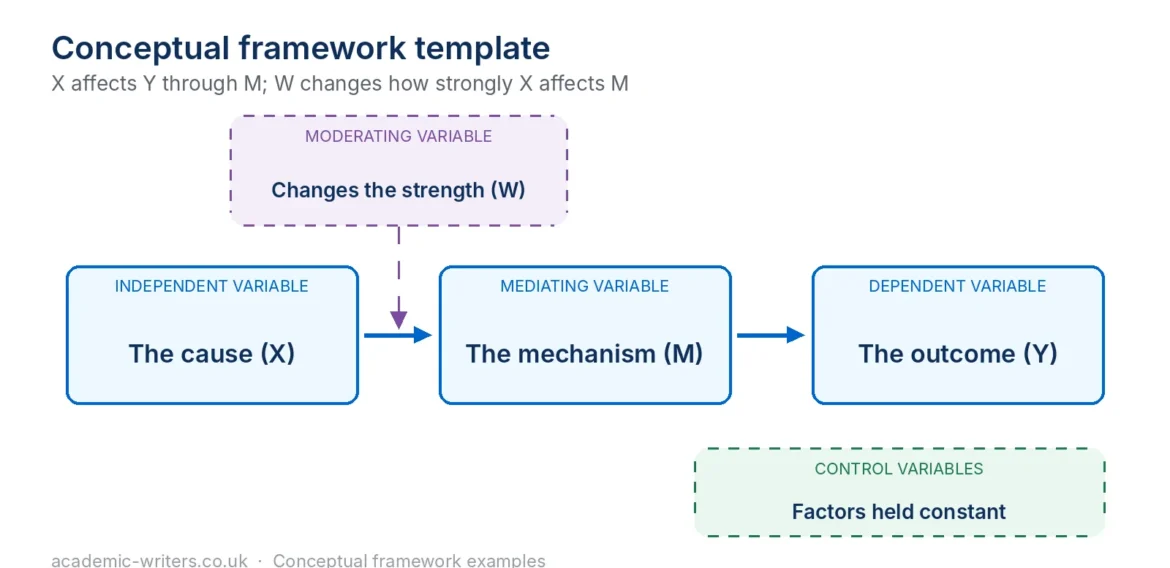
Conceptual Framework vs Theoretical Framework: 7 Powerful Differences (Easy Examples)
Few topics confuse dissertation students more than the conceptual framework vs theoretical framework question. Supervisors ask for “a framework”, module handbooks mention both, and online examples often use the terms as if they mean the same thing. They don’t — and mixing them up can weaken your literature review, your methodology and ultimately your mark.
This guide explains the difference in plain English, shows when to use each one, gives worked examples from business, nursing, education and psychology, and walks you through how to build both for your own dissertation or thesis.
Conceptual Framework vs Theoretical Framework: Quick Definitions
A theoretical framework is built on one or more existing, established theories (for example, Maslow’s Hierarchy of Needs, the Technology Acceptance Model or Social Learning Theory). It explains why a phenomenon happens and gives your study a lens borrowed from the wider academic literature.
A conceptual framework is your own map of the key concepts or variables in your study and how you expect them to relate to each other. It is usually drawn as a diagram and is specific to your research question, population and context.
Put simply: the theoretical framework is the borrowed theory; the conceptual framework is your model of how that theory (and other evidence) plays out in your study. For more detailed illustrations, see our collection of conceptual framework examples and theoretical framework examples.
Conceptual Framework vs Theoretical Framework: Comparison Table
| Feature | Theoretical framework | Conceptual framework |
|---|---|---|
| Source | Existing, tested theories from the literature | Researcher’s own synthesis of theory, literature and context |
| Scope | Broad — applies across many studies | Narrow — specific to your research question |
| Purpose | Explains why relationships exist | Shows which variables you study and how they connect |
| Typical format | Written discussion of theory and its assumptions | Diagram with boxes and arrows, plus explanation |
| Best suited to | Deductive, theory-testing research | Both deductive and inductive research |
| Where it appears | Literature review or a dedicated theory chapter | End of literature review or start of methodology |
| Example | Theory of Planned Behaviour | Attitudes + social norms + perceived control → intention to buy sustainable fashion among UK students |
What Is a Theoretical Framework?
To understand the conceptual framework vs theoretical framework debate properly, start with theory.
A theoretical framework is the structure that holds or supports a theory of a research study. It introduces and describes the theory that explains why the research problem exists. It answers questions such as:
- Which established theory best explains the phenomenon I am studying?
- What assumptions does that theory make?
- What does the theory predict I will find?
In quantitative studies, a theoretical framework often generates hypotheses. In qualitative studies, it acts as a sensitising lens that shapes interview questions and coding. Either way, it connects your project to the wider body of knowledge and shows examiners that your study is grounded in scholarship rather than opinion.
Examples of Theories Commonly Used in UK Dissertations
- Business and management: Resource-Based View, Stakeholder Theory, Agency Theory, Porter’s Five Forces.
- Marketing: Theory of Planned Behaviour, Technology Acceptance Model, Uses and Gratifications.
- Nursing and health: Health Belief Model, Orem’s Self-Care Theory, Roy’s Adaptation Model.
- Education: Constructivism, Social Learning Theory, Self-Determination Theory.
- Psychology: Attachment Theory, Cognitive Dissonance, Social Identity Theory.
What Is a Conceptual Framework?
The second half of the conceptual framework vs theoretical framework comparison is your own model.
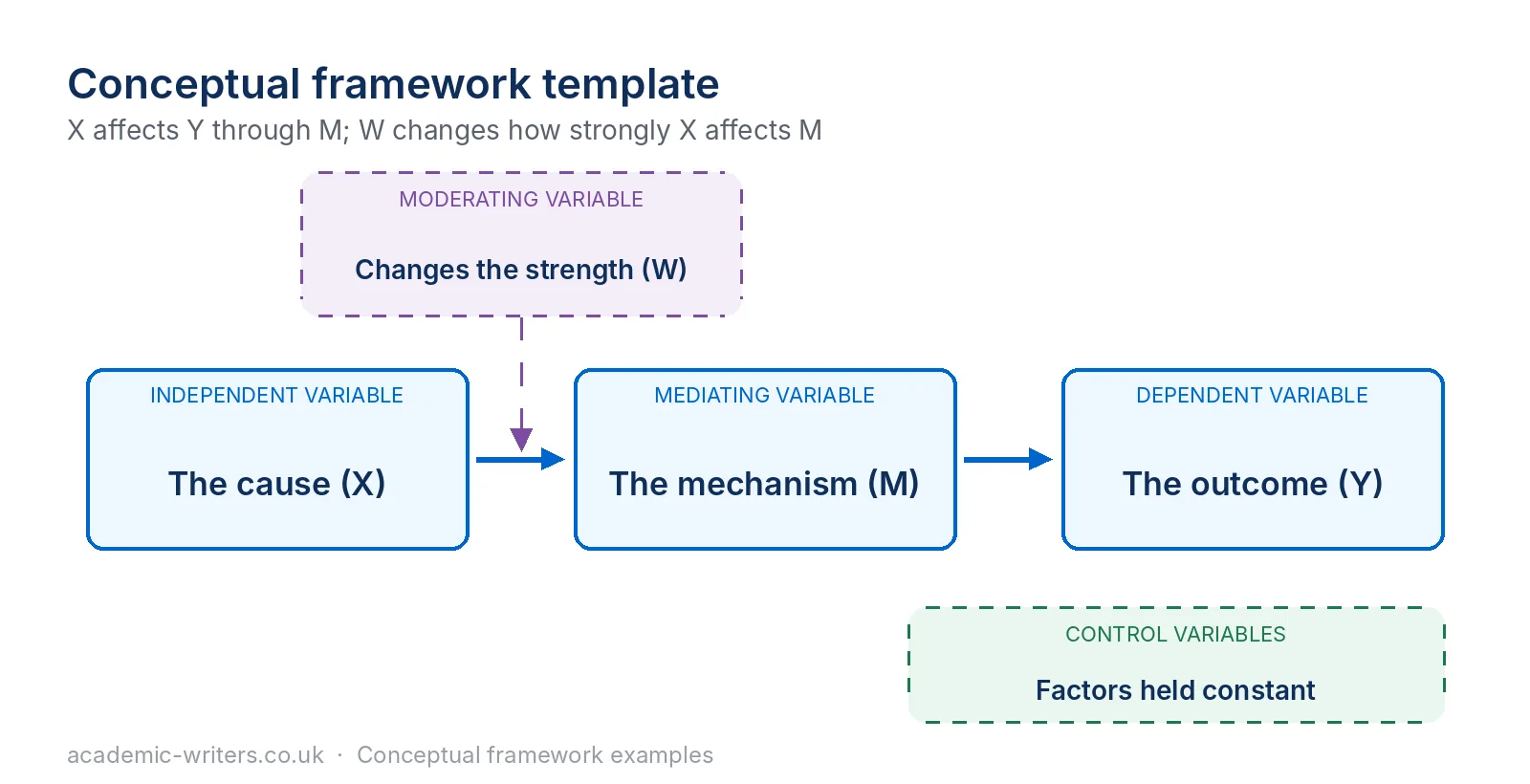
A conceptual framework is a visual or written model that identifies the main concepts in your study and shows the relationships you expect between them. It is built from your literature review, your chosen theory (if any) and your research context.
A good conceptual framework usually includes:
- Independent variables — the factors you think influence the outcome;
- Dependent variables — the outcome you are explaining;
- Mediating or moderating variables — factors that change the strength or direction of a relationship;
- Context — the setting, population or time frame.
Conceptual Framework vs Theoretical Framework: Worked Examples
Example 1: Business — Remote Working and Productivity
Theoretical framework: Self-Determination Theory, which proposes that autonomy, competence and relatedness drive motivation.
Conceptual framework: Flexible scheduling (autonomy) + access to digital tools (competence) + virtual team contact (relatedness) → employee motivation → perceived productivity among UK tech employees, moderated by caring responsibilities.
Example 2: Nursing — Medication Adherence
Theoretical framework: The Health Belief Model.
Conceptual framework: Perceived severity of hypertension + perceived benefits of medication − perceived barriers (side effects, cost) + cues to action (GP reminders) → medication adherence among adults aged 50+ in an NHS primary-care setting.
Example 3: Education — Online Learning Engagement
Theoretical framework: Constructivist learning theory.
Conceptual framework: Interactive activities + peer discussion + timely tutor feedback → student engagement → academic performance in first-year undergraduate online modules.
Example 4: Psychology — Social Media and Self-Esteem
Theoretical framework: Social Comparison Theory.
Conceptual framework: Time on image-based platforms + upward comparison frequency → self-esteem among 18–24-year-old university students, moderated by gender.
In each example the theory provides the explanation, while the conceptual framework turns that explanation into specific, measurable relationships for one study.
Conceptual Framework vs Theoretical Framework: Do You Need Both?
Not always. Here is a practical rule of thumb:
- Quantitative, theory-testing study: use a theoretical framework and derive a conceptual framework from it. Most marking schemes reward having both.
- Qualitative, exploratory study: a conceptual framework drawn from the literature is often enough; a theory may be used loosely as a lens.
- Grounded theory study: you may deliberately avoid a fixed theoretical framework and build a conceptual model from your data.
- Mixed methods: typically both, with the conceptual framework linking quantitative and qualitative strands.
Always check your module handbook and ask your supervisor which they expect. Many UK universities explicitly mention the conceptual framework vs theoretical framework distinction in their marking rubrics.
How to Build a Theoretical Framework in 5 Steps
- Start with your problem statement. A clear problem points you towards relevant theories. Our problem statement examples show how to write one.
- Search the literature for theories used in similar studies. Note which theories appear repeatedly and why.
- Evaluate competing theories. Compare their assumptions, strengths and limitations for your context.
- Select and justify. Explain why your chosen theory fits better than the alternatives.
- Link theory to your research questions. Show how each research question or hypothesis comes from the theory.
How to Build a Conceptual Framework in 6 Steps
- Clarify your research aims and objectives. See our guide to dissertation aims and objectives and these research objectives examples.
- List the key concepts or variables from your research questions.
- Review the literature to find evidence for relationships between them.
- Decide the direction of relationships (which variable influences which).
- Draw the diagram using boxes for concepts and arrows for relationships; label hypotheses (H1, H2…) if you are testing them.
- Explain the diagram in writing, citing the literature that supports each link.
Conceptual Framework vs Theoretical Framework: Common Mistakes to Avoid
- Using the terms interchangeably. Examiners notice. Define each one clearly.
- Listing theories without applying them. A theory must shape your questions, methods and analysis.
- Over-complicated diagrams. Ten variables and twenty arrows rarely fit a 15,000-word dissertation.
- Framework disconnected from methods. Every variable in your conceptual framework should be measured or explored in your data collection.
- Forgetting to revisit the framework. Your discussion chapter should explain whether your findings support, extend or challenge it. The Scribbr guide to conceptual frameworks offers further reading on this.
Where Do the Frameworks Go in Your Dissertation?
Placement is another practical part of the conceptual framework vs theoretical framework decision.
The theoretical framework usually sits within the literature review or in a dedicated “Theoretical Framework” section. The conceptual framework normally appears at the end of the literature review, acting as a bridge into the methodology. Some programmes, particularly in nursing and education, ask for a separate chapter. If you are unsure, our dissertation outline writing service can help you plan where each element belongs.
Need Help With Your Dissertation Framework?
Getting the conceptual framework vs theoretical framework balance right is one of the fastest ways to raise your mark. Our UK academic writers have supported thousands of students with frameworks, proposals and full dissertations:
- Dissertation writing services UK — expert support on every chapter.
- Dissertation proposal writing service — build a framework your supervisor will approve.
- Masters dissertation help — tailored guidance for MSc, MA and MBA projects.
- PhD dissertation writing service — support for complex theoretical chapters.
- Thesis writing service — for research degrees and long-form theses.
Ready to start? Get a free price quote in minutes.
Frequently Asked Questions
What is the main difference between a conceptual framework and a theoretical framework?
A theoretical framework is based on existing, established theories, while a conceptual framework is the researcher’s own model of how the specific variables in a study relate to one another.
Can a dissertation have both a conceptual and a theoretical framework?
Yes. Many strong dissertations use a theoretical framework to justify the study and a conceptual framework to show exactly which variables will be investigated.
Which comes first, the theoretical or the conceptual framework?
Usually the theoretical framework comes first, because the conceptual framework is built on it and on the wider literature.
Is a conceptual framework always a diagram?
Most are presented as diagrams, but they must always be explained in writing with supporting citations.
Do qualitative studies need a theoretical framework?
Not always. Exploratory and grounded theory studies may rely on a conceptual framework or develop theory from the data.
Conclusion
The conceptual framework vs theoretical framework distinction is simple once you see it: theory explains, and your conceptual model applies that explanation to your study. Choose a theory that fits your problem, translate it into clear variables and relationships, and carry both through your methodology, findings and discussion. Do that, and your dissertation will have the coherence examiners look for in top-band work.